Getting Started: Your First Home Buying Journey
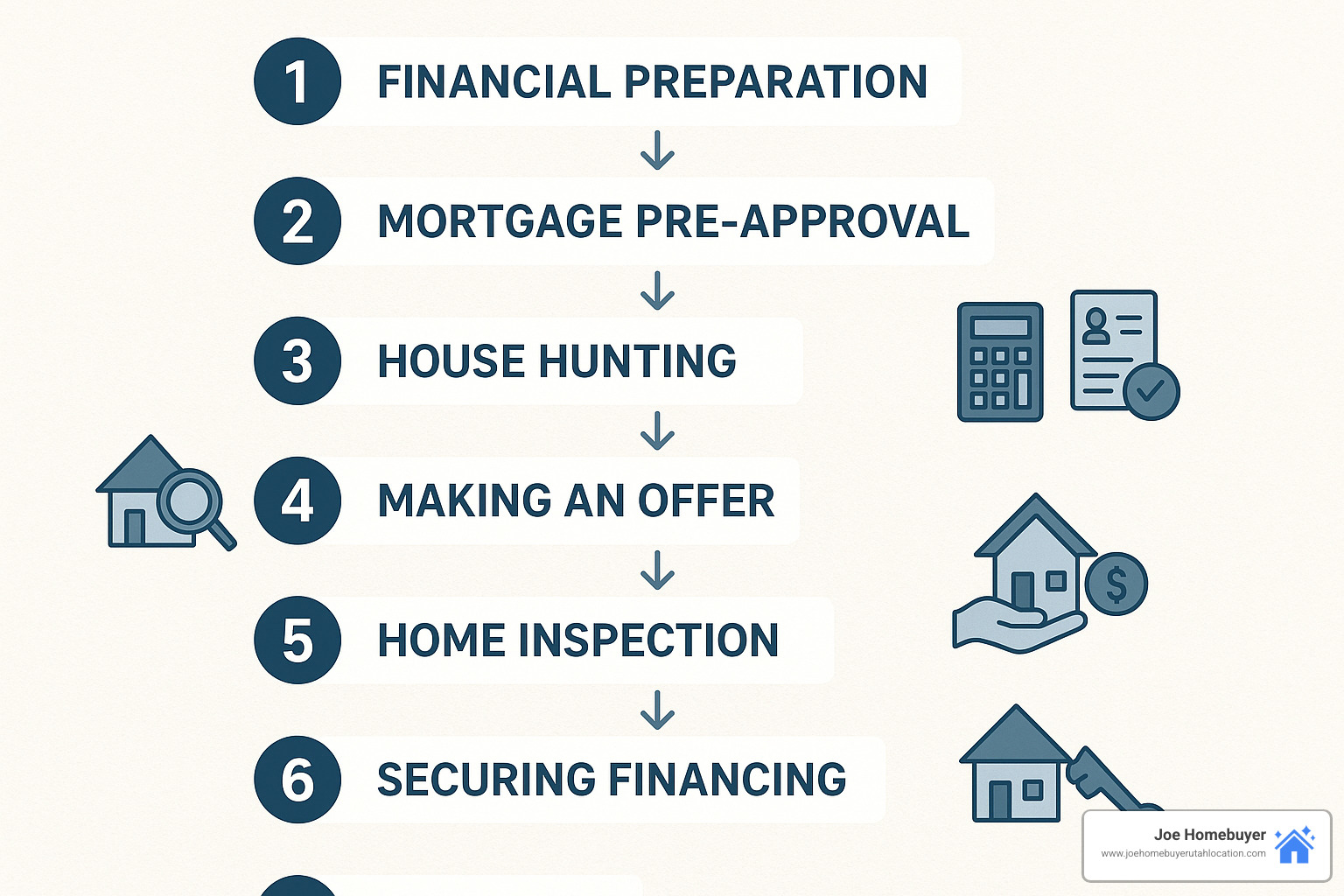
First time home buying for dummies is a process that can feel overwhelming, but breaking it down into manageable steps makes it achievable for anyone. Here’s what you need to know right away:
Quick Guide to First Time Home Buying:
- Check your finances – Aim for a credit score of at least 620 and save for a down payment (3-20%)
- Get pre-approved – Shop multiple lenders before house hunting
- Set a realistic budget – Calculate PITI (Principal, Interest, Taxes, Insurance)
- Find an agent – Interview multiple real estate agents
- Make a strong offer – Include contingencies for inspection and financing
- Complete inspections – Never skip this step
- Close the deal – Review all documents carefully
Buying your first home is one of life’s most exciting milestones, but it can also be terrifying if you don’t understand the process. The good news is that you don’t need to be a real estate expert to make smart decisions. You just need to follow a clear roadmap and avoid common pitfalls.
Many first-time buyers make the mistake of starting their home search online before they’ve sorted out their finances or gotten pre-approved for a mortgage. This approach sets you up for disappointment when you fall in love with homes you can’t afford.
Instead, begin by honestly assessing your financial readiness. Are you stable in your career? Do you have emergency savings beyond your down payment? Is your credit score in good shape? These foundations will determine your buying power.
I’m Joe Darger, CEO of Joe Homebuyer of Utah, and I’ve helped hundreds of Utah homeowners steer real estate transactions, giving me unique insights into first-time home buying for dummies that I’m excited to share with you in this guide.
First Time Home Buying for Dummies: The Essentials List
Thinking about scrolling through dream homes on Zillow? Hold up! Before you fall in love with a property you can’t afford, let’s get your financial foundation solid first. This is first time home buying for dummies 101 – start with your wallet, not your wishlist!
Can you actually afford a home right now? Lenders will scrutinize your debt-to-income (DTI) ratio, which shows how much of your monthly income goes toward debt payments. Ideally, keep this under 36%, though some flexible lenders might stretch to 43% for otherwise strong applicants.
Calculating your DTI is simple: add up your monthly debt payments (credit cards, student loans, car loans), divide by your monthly pre-tax income, then multiply by 100. If you pay $2,000 in monthly debts and earn $6,000 monthly, your DTI is 33% – looking good!
Beyond DTI, your home-buying toolkit needs:
- A down payment (typically 3-20% of the home price)
- A healthy emergency fund (covering 3-6 months of expenses)
- Extra cash for closing costs (2-5% of your loan)
- Money for moving and those inevitable first-month home repairs
Here’s how different down payments affect a $300,000 home purchase:
| Down Payment | Percentage | Amount | Loan Amount | Monthly Payment* | PMI Required? |
|---|---|---|---|---|---|
| Minimum | 3% | $9,000 | $291,000 | ~$1,940 | Yes |
| Middle | 10% | $30,000 | $270,000 | ~$1,800 | Yes |
| Conventional | 20% | $60,000 | $240,000 | ~$1,600 | No |
*Estimated monthly payment includes principal, interest, taxes, and insurance (PITI) at current rates. Your actual payment will vary.
Are You Really Ready? — first time home buying for dummies self-check
Being financially qualified doesn’t automatically mean you’re ready for homeownership. Let’s run through a quick reality check:
Job stability matters tremendously. Have you been earning steady paychecks for at least two years? Lenders get nervous about job-hoppers and recent career changers.
Income predictability affects your mortgage worthiness too. If your income bounces around (hello, commission-based sellers and freelancers!), lenders may hesitate or require more documentation.
Location commitment is crucial – are you planning to put down roots for at least 3-5 years? As one housing expert bluntly puts it, “If you don’t hold a home for at least three (preferably five) years, you could lose money” after factoring in transaction costs.
Lifestyle alignment deserves honest consideration. Will a mortgage payment and weekend maintenance projects support your life goals, or derail them? That dream of spending six months backpacking might need adjustment if you’re paying for a vacant house back home.
Maintenance readiness isn’t just about affording repairs – it’s about handling the responsibility. When the toilet overflows at midnight, there’s no landlord to call!
Budget Like a Pro — first time home buying for dummies math
First time home buying for dummies requires mastering the real cost of homeownership, which extends far beyond your mortgage payment.
Your monthly housing expenses include the famous PITI bundle:
- Principal and Interest: The actual mortgage repayment
- Property Taxes: Usually 1-2% of your home’s value annually
- Insurance: Protecting your property investment
- Mortgage Insurance: Required with down payments under 20%
But wait, there’s more! Don’t forget these budget-busters:
HOA fees can add $30-$500 monthly if you’re buying in a managed community. Always factor these in before falling in love with that condo!
Utility bills often shock former apartment dwellers. Heating and cooling an entire house costs more than a cozy apartment.
Maintenance costs average 1-3% of your home’s value annually. That’s $3,000-$9,000 yearly on a $300,000 home – not pocket change!
Emergency repairs happen at the worst times. Budget for them or risk putting that leaking roof on a high-interest credit card.
Home improvements will tempt you immediately. That 1970s kitchen might need more than just a deep clean!
The magic number? Try to keep all housing expenses under 28% of your gross monthly income. Earning $6,000 monthly means aiming for housing costs around $1,680 maximum. This prevents becoming “house poor” – owning a beautiful home but eating ramen every night to afford it.
Smart savers set up automatic transfers to a dedicated down payment fund. Time this with your paycheck schedule, and you’ll build your home-buying nest egg painlessly. For more expert guidance on down payments, check out the Consumer Financial Protection Bureau’s guide to determining your down payment.
Financing Toolbox: Loans, Scores & Pre-Approval
Now that you’ve checked your readiness and figured out your budget, let’s talk about the money side of things. Understanding your financing options is a crucial part of first time home buying for dummies – and it doesn’t have to be complicated!
Think of mortgages as different flavors of ice cream – they all help you buy a home, but each has its own unique characteristics that might make it a better fit for your situation.
Here are the main types you’ll encounter:
- Conventional Loans: These are the “vanilla” of mortgages – common and straightforward. You’ll typically need at least 3-20% down and a credit score of 620 or higher. These loans follow guidelines set by Fannie Mae and Freddie Mac.
- FHA Loans: Perfect if your credit isn’t stellar. These government-backed options require as little as 3.5% down with a credit score of 580+. Even scores between 500-579 might qualify if you can put 10% down.
- VA Loans: A special thank-you to veterans and active service members, offering 0% down payment options with no private mortgage insurance. These are truly one of the best deals in mortgage lending.
- USDA Loans: Don’t let the name fool you – you don’t need to be a farmer! These are for homes in rural and some suburban areas, offering 0% down payment for qualified buyers.
- Jumbo Loans: For when you’re dreaming big. These loans exceed the standard limits (currently $726,200 in most areas) and typically require larger down payments and excellent credit.
Current interest rates hover around 6.83% for conventional loans, 7.35% for FHA loans, 6.42% for VA loans, and 6.79% for jumbo loans. But remember, rates change daily, so check the latest numbers when you’re ready to apply.
Your credit score is like your financial report card – it significantly impacts both your approval odds and the interest rate you’ll receive. According to Experian’s research, here’s how your score affects your mortgage prospects:
A score of 740 or higher will get you the red carpet treatment with excellent rates and terms. Between 700-739, you’ll still get very good rates, while 660-699 means good rates but not the absolute best. If you’re in the 620-659 range, you’ll face higher rates but should still get approved for most loans.
Scores below 620 start getting tricky – 580-619 may qualify for FHA with 3.5% down, while 500-579 might qualify with 10% down. Below 500? You’ll have a very tough time getting approved for any mortgage.
Don’t underestimate the impact of even a small rate difference! A mere 0.5% can mean paying (or saving) tens of thousands of dollars over your loan’s lifetime.
Pick Your Loan Flavor
Beyond the main loan types, you’ll need to decide between fixed-rate and adjustable options:
Fixed-Rate Mortgages are like comfort food – reliable and predictable. Your interest rate stays the same for the entire loan term (usually 30, 20, or 15 years). Your monthly payment never changes, making budgeting a breeze. These are ideal when interest rates are low or when you plan to stay put for a long time.
Adjustable-Rate Mortgages (ARMs) start with a steady rate for an initial period (commonly 5, 7, or 10 years), then adjust periodically afterward. They typically begin with lower rates than fixed mortgages, making them attractive if you plan to move or refinance before the adjustment period kicks in.
You might also hear about mortgage points – fees you can pay upfront to lower your interest rate. One point typically costs 1% of your loan amount and reduces your rate by about 0.25%. On a $300,000 loan, one point costs $3,000 and might reduce your rate from 6.5% to 6.25%. Whether this makes sense depends on how long you’ll keep the mortgage – the longer you stay, the more those points pay off.
Once you’ve found your dream home and are under contract, consider a rate lock. This guarantees your interest rate for a specific period (usually 30, 45, or 60 days), protecting you if rates rise before closing. Think of it as an insurance policy for your interest rate!
Boost Your Credit Fast
Need to give your credit score a quick shine before applying? Focus on these high-impact strategies:
Your payment history accounts for 35% of your score, so make every payment on time. Set up automatic payments if you tend to forget. Credit utilization (how much of your available credit you’re using) makes up 30% of your score – aim to keep card balances below 30% of your limits. Paying down high balances can boost your score surprisingly quickly.
The length of your credit history (15% of your score) matters too, so keep those old accounts open, even if you rarely use them. Having a good credit mix (10%) with both installment loans and revolving credit helps demonstrate your ability to manage different types of debt. And be careful with new credit (10%) – avoid opening new accounts when preparing to buy a home.
A smart tip that few people know: check your credit reports for errors that might be dragging down your score. You can get free reports from all three major bureaus at AnnualCreditReport.com. Found an error? Dispute it immediately – fixing mistakes can give your score a significant boost.
Here’s another insider tip: ask your credit card companies to increase your limits (without actually using the additional credit). This instantly lowers your utilization ratio and can bump up your score with minimal effort.
Get Pre-Approved & Lock Funds
Before you start browsing homes online or visiting open houses, get pre-approved for a mortgage. This is like getting a financial physical – a lender reviews your finances and credit to determine how much they’re willing to lend you.
For pre-approval, you’ll need to gather some paperwork: proof of income (recent pay stubs, W-2s and tax returns from the last two years), proof of assets (bank and investment account statements), your credit information, employment verification, and personal identification like your Social Security number and driver’s license.
A pre-approval letter gives you serious advantages in your home search. Sellers will see you as a serious, qualified buyer rather than just a window-shopper. It helps you shop within your actual budget (not what you think you can afford), and it streamlines the final loan process once you find “the one.”
Don’t confuse pre-approval with pre-qualification. Pre-qualification is just a quick estimate based on what you tell the lender, while pre-approval involves actually verifying your financial information. It’s the difference between “you might qualify” and “you do qualify.”
Here’s where many first time home buying for dummies guides fall short: they don’t emphasize shopping around! Compare offers from at least 3-5 lenders. Research shows that getting just one additional rate quote can save you an average of $1,500 over your loan’s lifetime. That’s money in your pocket for new furniture or home improvements!
When comparing lenders, look beyond just the interest rate. Consider loan terms, closing costs, lender fees, and the company’s reputation for customer service. A slightly higher rate might be worth it if the lender is known for smooth, stress-free closings.
Finally, don’t forget to check if you qualify for down payment assistance. Many first-time buyers don’t realize there are programs designed specifically to help them! Use the Down Payment Assistance Tool to find programs in your area that might help with your down payment or closing costs. These programs can make homeownership possible much sooner than you might think.
House-Hunting & Offer Toolkit
Now comes the exciting part—finding your home! With your pre-approval in hand and budget clearly defined, you’re ready to start looking at properties.

Before you dive into home tours, take a moment to create two essential lists. Your must-haves are non-negotiable features like the number of bedrooms, school district quality, maximum commute time, specific neighborhoods, or parking requirements. Your nice-to-haves might include an updated kitchen, finished basement, fenced yard, home office, or a particular architectural style you love.
This clarity will save you countless hours and prevent the heartbreak of falling for homes that don’t actually meet your fundamental needs. Trust me, I’ve seen too many first-time buyers get distracted by shiny features only to regret their compromise on essentials later.
When researching neighborhoods, dig deeper than just driving through. Look at school ratings (even without children, this significantly impacts resale value), check crime statistics, measure commute times to work, explore nearby shopping and recreation options, and investigate future development plans. Don’t forget to check property tax rates and potential environmental concerns like flood zones.
Utah’s diverse communities offer something for everyone. Salt Lake City neighborhoods pulse with urban energy, while Sandy and West Jordan provide family-friendly suburban vibes. Market conditions and home prices vary significantly between Provo, Ogden, and St. George, so local research is essential for first time home buying for dummies.
Choose the Right Agent
A skilled buyer’s agent is worth their weight in gold when navigating your first home purchase. They’ll provide market insights, handle tough negotiations, and guide you through the mountain of paperwork and processes.
When interviewing potential agents, ask about their experience with first-time buyers, knowledge of your target neighborhoods, availability for showings, and communication style. Request references from recent clients and inquire about their approach to multiple-offer situations. Also clarify their fee structure and whether you’ll work directly with them or a team member.
After selecting an agent, you’ll likely sign a buyer’s agency agreement outlining their responsibilities, compensation, and the agreement’s duration. These terms are negotiable—don’t hesitate to request modifications if something doesn’t feel right for your situation.
Tour Like a Detective
When viewing homes, try to look beyond pretty staging and cosmetic features. Train your eyes to notice structural elements like foundation cracks, water stains, uneven floors, and doors that don’t close properly. Examine mechanical systems including the HVAC age, electrical panel capacity, water heater condition, and plumbing.
Outside, assess the roof condition, check drainage around the foundation, and evaluate the siding quality. Consider neighborhood factors by visiting at different times to observe traffic patterns, noise levels, and how well neighbors maintain their properties.
Take plenty of photos and detailed notes during tours—homes start to blur together after you’ve seen several. Don’t rush this process; visit promising properties multiple times if possible, including weekday evenings and weekends to get the full picture of daily life there.
While focusing on your current needs, also consider future resale value. Homes with three or more bedrooms, at least two bathrooms, open floor plans, updated kitchens and bathrooms, home office space, good natural light, and adequate parking typically maintain stronger appeal to future buyers.
Craft a Winning Offer
When you find “the one,” it’s time to make an offer that stands out. Your agent will help determine an appropriate price based on comparable recent sales (comps), current market conditions, the property’s condition, days on market, and any known seller motivation.
A Comparative Market Analysis (CMA) is your best friend here. This tool examines similar recently sold properties to help determine fair market value and guide your offer strategy.
Your offer will include the purchase price, earnest money deposit (typically 1-3% showing your serious intent), contingencies that protect your interests, proposed closing timeline, items included in the sale, and an expiration date for the seller’s response.
Contingencies are your safety net in the first time home buying for dummies process. The financing contingency protects you if your loan falls through, while the inspection contingency allows renegotiation based on inspection findings. An appraisal contingency safeguards you if the home appraises below your offer price.
In competitive markets, consider strengthening your offer with an escalation clause that automatically increases your bid up to a maximum amount if competing offers appear. You might also offer a larger earnest money deposit, flexibility on the closing date, or a personal letter explaining why you love the home (though some markets now discourage this practice).
Everything is negotiable. The seller may accept your offer outright, reject it completely, or—most commonly—counter with modifications. Be prepared for some back-and-forth, and don’t take negotiations personally. Your agent’s experience will prove invaluable during this emotional stage of the process.
For more guidance on making competitive offers in today’s market, check out Making an offer for additional resources and strategies.
Inspection, Insurance & Closing Kit
Once your offer is accepted, you enter what I like to call the “verification phase.” This is your chance to confirm the home is everything you hoped for—and to protect yourself from any surprises.

First up is the home inspection—absolutely worth the $300-$500 investment. Think of this as your home’s physical exam. A professional inspector will thoroughly examine everything from the foundation to the roof, including electrical systems, plumbing, HVAC, appliances, and structural elements.
I always recommend attending the inspection if possible. Walk alongside the inspector, ask questions, and learn about your potential new home. You’ll receive a detailed report afterward, often highlighting issues you never noticed during your tours (those rose-colored glasses we wear when house-hunting are very real!).
While the inspection is happening, your lender will order an appraisal. This isn’t just paperwork—it’s your protection against overpaying. The appraiser determines the home’s fair market value, which affects your loan approval.
Now’s also the time to shop for homeowners insurance. Don’t just go with the first quote you get! Compare policies and make sure you’re covered for:
- The dwelling itself (the actual structure)
- Your personal belongings inside the home
- Liability protection (in case someone gets injured on your property)
- Additional living expenses if you can’t live in your home temporarily
Here in Utah, we have some specific considerations. You might want additional coverage for earthquakes or wildfires, as these typically aren’t included in standard policies. A local insurance agent can help you understand what makes sense for your specific location.
Behind the scenes, a title company will be conducting a title search. They’re looking for any liens, easements, or ownership issues that could come back to haunt you later. You’ll also purchase title insurance to protect against any problems the search might miss.
Inspection Power Moves
The inspection report has arrived, and—surprise!—the house isn’t perfect. Now what?
This is where first time home buying for dummies gets real. You have several options when issues arise:
You can request repairs, asking the seller to fix specific problems before closing. This works well for safety issues or major systems that aren’t functioning properly.
Alternatively, you might request credits at closing. This puts money in your pocket to handle repairs yourself, which often gives you more control over the quality and timing of the work.
You could also renegotiate the price to reflect the home’s true condition. A $10,000 price reduction might make that aging roof much more acceptable.
Sometimes, especially in hot markets, you might decide to accept the home as-is if the issues are minor. And if the problems are truly significant, you can typically walk away and get your earnest money back (assuming you have an inspection contingency).
Some issues should make you seriously consider hitting the brakes: structural problems, major roof damage, electrical or plumbing nightmares, extensive mold, foundation issues, or environmental hazards. These can be expensive and complicated to fix.
For smaller issues—a leaky faucet or cracked tile—consider whether it’s worth potentially derailing your purchase. Sometimes it’s better to handle minor repairs yourself after closing.
Your agent will help draft any repair requests or amendments to the purchase agreement. Be specific about what you want fixed, who should do the work, and what standards you expect.
Understand Your Appraisal & PMI
The appraisal results are in—this is a crucial moment. If the home appraises at or above your offer price, you’ll proceed as planned. If it comes in below, you have decisions to make.
You could make up the difference in cash (not ideal for most first-time buyers), try to renegotiate with the seller (who may or may not budge), request a second appraisal if there seems to be an error, or potentially cancel the contract if you have an appraisal contingency.
The appraisal also determines your loan-to-value (LTV) ratio, which directly impacts whether you’ll need Private Mortgage Insurance (PMI). If your down payment is less than 20% (meaning your LTV exceeds 80%), you’ll typically pay PMI.
This insurance protects the lender—not you—but you’re the one paying for it. PMI usually costs between 0.5% and 1% of your loan amount annually. On a $300,000 loan, that translates to $1,500-$3,000 per year, or $125-$250 monthly. That’s real money!
The silver lining? PMI isn’t forever. Once you reach 20% equity through a combination of your payments and home appreciation, you can request PMI removal. It automatically terminates at 22% equity based on your original payment schedule.
If your home increases in value significantly (as many Utah homes have in recent years), you can request a new appraisal to demonstrate that your LTV has dropped below 80%, potentially eliminating PMI sooner than expected.
Sign & Get Keys
As closing day approaches, you’ll receive a Closing Disclosure at least three business days before signing. This isn’t just another document—it’s your financial blueprint for this purchase. Review it carefully and compare it to your Loan Estimate to ensure there are no unexpected changes in terms or fees.
The Closing Disclosure details your loan terms, projected monthly payments, closing costs, and the cash you’ll need to bring to closing. If anything looks different than expected, speak up immediately.
Don’t skip the final walkthrough! Schedule this 24 hours before closing to verify that all agreed-upon repairs have been completed, the property is in the expected condition, included items remain in the home, and all systems are functioning properly. This is your last chance to identify issues before the home becomes yours.
On closing day, bring your government-issued photo ID, cashier’s check or wire transfer confirmation for closing costs, proof of homeowners insurance, and any outstanding documents requested by the lender or title company.
Be prepared to sign. A lot. The closing process involves numerous documents including the mortgage note, mortgage or deed of trust, deed, various affidavits, and the closing disclosure. Take your time and ask questions about anything you don’t understand.
Important safety tip: Be extremely cautious about wire transfers. Wire fraud is increasingly common in real estate transactions. Always confirm wire instructions by phone using a number you’ve independently verified before sending money. Scammers often try to intercept these transactions by sending fake instructions that look legitimate.
After all documents are signed and funds transferred, you’ll receive the keys to your new home. Take a moment to celebrate this milestone—you’ve successfully steerd the first time home buying for dummies process and become a homeowner!
For more information about protecting your investment, check out the Consumer Financial Protection Bureau’s guide to homeowners insurance.
Post-Purchase Survival Pack
The journey doesn’t end at closing. Now comes the responsibility of maintaining your investment and managing your new financial obligations.

Congratulations on your new home! That moment when you finally get the keys is magical, but it’s also just the beginning of your homeownership journey. Think of this first time home buying for dummies section as your survival guide for those crucial first years.
Let’s start with something practical: your home maintenance calendar. Your home is like a living thing that needs different care as the seasons change. In spring, you’ll want to check for any winter damage, clean those gutters, inspect your roof, service your air conditioning, and test smoke detectors. When summer rolls around, focus on outdoor maintenance—inspect your deck or patio, check irrigation systems, trim trees and shrubs, and keep an eye out for any unwelcome pest visitors.
As leaves begin to fall in autumn, those gutters will need cleaning again (I know, not fun!), your heating system should be serviced, and it’s time to winterize outdoor faucets and check weatherstripping. During the cold winter months, watch for ice dams, monitor for leaks during storms, and make sure your attic insulation is doing its job.
“My first winter as a homeowner, I completely forgot to disconnect my garden hose,” laughs Sarah, a first-time homeowner in Salt Lake City. “One frozen pipe and $400 later, I learned my lesson and created a seasonal checklist!”
Your financial responsibilities don’t end at the mortgage payment. You’ll need to budget for property taxes (which tend to increase annually), homeowners insurance premiums, utilities, and of course, maintenance costs. If you’re in a neighborhood with an HOA, don’t forget those dues as well.
One of the smartest moves you can make as a new homeowner is establishing a dedicated emergency fund specifically for home repairs. Aim to set aside 1-2% of your home’s value annually. It might seem like a lot, but when your water heater decides to call it quits on a holiday weekend, you’ll be grateful for that cushion.
Stay organized with your paperwork! Keep a folder (physical or digital) with all your closing documents, home warranty information, appliance manuals, contractor information, insurance policies, and property tax records. Future you will thank present you for this simple step.
Keep an eye on mortgage rates, too. If rates drop significantly (usually by at least 0.5-1%), refinancing might make sense depending on how long you plan to stay in your home. The math is simple: if you’ll save more over time than the cost of refinancing, it’s worth considering.
As you build equity through mortgage payments and home appreciation, you gain financial flexibility. Some homeowners tap into this equity through home equity loans or lines of credit for major improvements or other significant expenses. Just remember that this puts your home at risk if you can’t make payments, so proceed with caution.
For Utah homeowners specifically, our local market has its own unique patterns and trends. The housing landscape here has changed dramatically in recent years, with different impacts across cities from St. George to Logan. Understanding these patterns helps you make smarter decisions about improvements, refinancing, or eventually selling. For a deeper dive into what’s happening locally, check out our article on Exploring the Housing Market Predictions for the Next 5 Years in Utah with Joe Homebuyer.
Homeownership is both a journey and a learning experience. You’ll make mistakes (we all do!), but with this first time home buying for dummies guide in hand, you’re already ahead of the curve. Enjoy your new home—you’ve earned it!
Frequently Asked Questions about First Homes
How much should I save beyond the down payment?
The down payment is just the beginning of your homebuying journey. Think of it as the ticket that gets you in the door – but there are plenty of other expenses waiting on the other side!
Most first-time buyers are shocked by how quickly costs add up beyond that initial down payment. Closing costs typically run between 2-5% of your loan amount. On a $300,000 home, you’re looking at $6,000-$15,000 just to finalize the paperwork! These include loan origination fees, title insurance, appraisal fees, and all those other mysterious line items that appear on your closing disclosure.
Then there’s the actual move itself. Whether you’re bribing friends with pizza or hiring professionals, moving expenses can easily run $1,000-$5,000 depending on how far you’re going and how much stuff you’ve accumulated.
Once you get those keys, you’ll likely want to make the place truly yours. Budget at least $1,000-$5,000 for immediate repairs or updates – things like changing the locks (always do this!), painting that purple bedroom a more soothing color, or fixing that leaky bathroom faucet the seller didn’t bother with.
The smart homebuyer also maintains a robust emergency fund – ideally covering 3-6 months of housing expenses. There’s no landlord to call when the water heater decides to flood your basement at 2 AM!
And let’s not forget the empty rooms that need filling. If you’re moving from a small apartment to a proper house, you might need $3,000-$10,000 for furniture and appliances, unless you enjoy eating dinner while sitting on moving boxes (been there, done that).
The bottom line? Aim to have your down payment plus an additional 7-10% of the home’s value saved before taking the plunge. Your future self will thank you when you’re not living on ramen noodles for the first year of homeownership!
What credit score gets me the best rate?
Your credit score is like your financial report card – and mortgage lenders are definitely checking your grades before deciding how much to charge you for borrowing hundreds of thousands of dollars.
While you might hear that you can qualify for a mortgage with scores as low as 500 (with an FHA loan and 10% down), the reality is that you’ll pay dearly for that privilege through much higher interest rates.
For truly attractive rates, aim for the 740+ club. Borrowers with scores in this range get the red-carpet treatment – the best rates and most favorable terms. It’s like flying first-class in the mortgage world.
Those with scores between 700-739 still get very good rates, just a touch higher than the absolute best offers. Think of it as premium economy – still comfortable, just paying a bit more.
In the 660-699 range, you’ll get good rates, but noticeably higher than top-tier borrowers. The difference might seem small – perhaps 0.5% higher – but that adds up enormously over a 30-year loan.
Borrowers with scores between 620-659 face higher rates but can still generally get approved for conventional loans. Below that, you’re looking at FHA territory, with 580-619 qualifying for 3.5% down payments but at higher rates, and 500-579 needing at least 10% down.
Here’s the sobering math: the difference between a 620 score and a 740+ score could cost you an extra $30,000-$60,000 over the life of a $300,000 mortgage. That’s a college education or a luxury car you’re giving away simply due to your credit score!
If you’re currently below 700, consider pressing pause on your home search for 6-12 months while you boost your score. The financial benefits are substantial, and in today’s housing market, patience often pays off.
Do I really need 20% to avoid PMI?
The 20% down payment rule is like flossing – everyone knows they should do it, but many people look for shortcuts! The good news is that while 20% down helps you avoid Private Mortgage Insurance (PMI), it’s not the only path to homeownership.
First time home buying for dummies often involves navigating the PMI question. Here’s the truth: there are several ways to avoid PMI with less than 20% down.
If you’ve served our country, VA loans offer an incredible benefit – 0% down with no PMI requirement. It’s one of the best mortgage products available, exclusively for veterans and active service members.
For the doctors among us, physician loans often waive PMI requirements despite lower down payments, recognizing the stable income and career trajectory of medical professionals.
Another creative approach is the piggyback loan strategy. This involves taking a first mortgage for 80% of the purchase price, a second mortgage (or home equity line of credit) for 5-15%, and making a down payment of just 5-15%. The result? No PMI, though you’ll have two loans to manage.
Some lenders also offer lender-paid PMI, where they cover the insurance in exchange for a slightly higher interest rate. This might sound appealing, but remember – unlike regular PMI which eventually goes away, you’ll pay that higher rate for the life of the loan unless you refinance.
Before you stretch to reach that 20% mark, consider that PMI typically costs 0.5-1% of your loan amount annually and is temporary. In Utah’s strong real estate market, home appreciation might help you eliminate PMI in just a few years as your equity grows.
Sometimes it makes more financial sense to accept PMI temporarily rather than emptying your savings account for a larger down payment. Having cash reserves for emergencies and home repairs often provides more security than avoiding PMI.
Plus, PMI is tax-deductible for many borrowers (subject to income limits), which lessens the impact on your monthly budget.
The best strategy depends on your specific situation – how long you plan to stay in the home, current interest rates, and your overall financial picture. Talk with your lender about running the numbers for different scenarios to find what works best for you. After all, first time home buying for dummies is all about making informed decisions that fit your unique circumstances!
Conclusion
Congratulations! You’ve made it through our first time home buying for dummies guide and now have the knowledge to steer the homebuying journey with confidence. Let’s take a moment to review what you’ve learned:
Remember when we started talking about assessing your readiness? That honest self-evaluation of your finances, credit score, and lifestyle readiness is truly the foundation of a successful home purchase. By setting a realistic budget that accounts for PITI plus those often-forgotten costs like maintenance and HOA fees, you’ve protected yourself from becoming “house poor.”
Securing the right financing makes all the difference in your homeownership experience. By shopping lenders, understanding your loan options, and getting pre-approved, you’ve positioned yourself as a serious buyer ready to make strong offers when you find “the one.”
Working with a skilled agent who understands your needs can transform the house-hunting process from overwhelming to exciting. They’ll help you look beyond staging to spot potential issues, understand neighborhood dynamics, and craft offers that stand out in competitive markets.
Never underestimate the power of due diligence! Those inspection reports might not make for exciting reading, but they’re your protection against unexpected surprises. Understanding the appraisal process and securing proper insurance creates a safety net for your investment.
When closing day arrives, you’ll be prepared to review all those documents with clarity, knowing exactly what you’re signing and why. That moment when you receive your keys will feel even sweeter knowing you’ve done everything right.
Homeownership is a journey that continues long after closing. By budgeting for ongoing expenses and staying on top of seasonal maintenance, you’re protecting your investment for years to come.
For Utah residents, we at Joe Homebuyer understand the unique aspects of our local market. While our primary business is helping homeowners sell quickly for cash, we’ve guided countless clients through property transitions across the state. From the vibrant neighborhoods of Salt Lake City to the family-friendly communities of West Jordan, Sandy, and throughout Utah, we’ve seen how proper preparation leads to homebuying success.
If you’re currently a homeowner looking to sell before purchasing your next property, our cash buying services might be the perfect solution. We offer quick, hassle-free sales with no repairs required and can close on your timeline – sometimes in as little as 7 days. This flexibility can be invaluable when coordinating the purchase of your next home. Learn more about selling your current home fast to help fund your new home purchase.
Buying a home is both a financial and emotional journey. Take your time, trust your research, and don’t let anyone pressure you into hasty decisions. The right home at the right price is absolutely worth waiting for.
Happy house hunting, and welcome to the rewarding world of homeownership!